Hip Flexor Tightness

The role of the hip flexors:

The hip flexor muscles include the iliacus and psoas major. Together these muscles act to lift the thigh up closer to the abdomen, which is the movement known as hip flexion. Excessive tightness of the hip flexor muscles is more likely to occur in certain people. It can lead to biomechanical abnormalities and be a source of pain. 
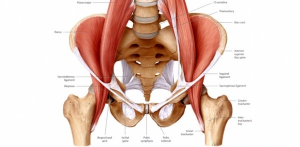
People that are more prone to hip flexor tightness:

People that have occupations that involve prolonged periods of sitting are prone to hip flexor tightness as the hips are in a sustained flexed position during sitting. People that engage in regular exercise such as running and cycling are also more prone to tight hip flexors. Sportspeople playing kicking sports such as soccer and football are also more likely to experience excessive flexor tightness as the kicking motion involves repetitive hip flexion movements. 

The consequences of tight hip flexors: 

Tight hip flexors can be a local source of pain around the hip joint which can be present during prolonged periods of sitting or during sporting activities that utilise the hip flexor muscles. Excessive tightness of the hip flexors can change lumbo-pelvic posture as it pulls the pelvis into an anteriorly tilted position. Increased anterior pelvic tilt increases the curve within the lumbar spine (lordosis) which in turn can cause the facet joint of the lumbar spine to be compressed more and tighten up surrounding back extensor muscles such as the erector spinae; this can lead to associated lower back pain

Tight hip flexors and altered alignment of the pelvis can also lead to over-activity of the hip flexor muscles and altered neuromuscular activity of the gluteal and core muscles which can further be a source of hip pain. 

Keeping in mind these exercises are just the basic exercise that we start off with to fully fix your knee injuries you will still need to continue to progress to harder and more functional exercises in order to feel pain free.

Here at Capital Physiotherapy, our physiotherapists are the experts in helping you to fix your hip/groin issues as well as all the discomfort that comes with it!

We can help you lead a healthier and pain free lifestyle. 

Our physiotherapist will be able to give an individualised advice/ treatment plan that is tailored for your particular needs.

 At Capital Physiotherapy, your initial appointment is 40-60minutes long. This allows our physios to be thorough in their assessment, as well as giving them enough time to give you treatment on the same consultation! 

If you have physiotherapy concerns and questions, don’t hesitate visit us at any of our clinics like in Footscray suburb or you may do online booking with us. We also provide Telehealth Consultation for your safety and convenience during this pandemic.
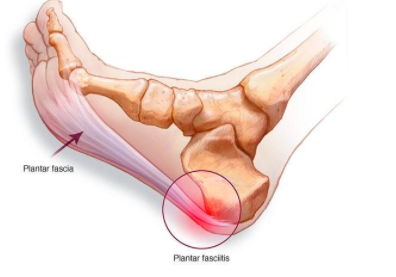
Heel Pain

Waking up with heel pain in the morning?

Do you experience heel pain first thing in the morning when you take your first few steps going to the bathroom?

If you are experiencing pain at this part of your heel, you most likely have what we call Plantar Fasciitis or the new term as we were told it’s called “plantar fasciopathy” or “plantar fasciosis”.

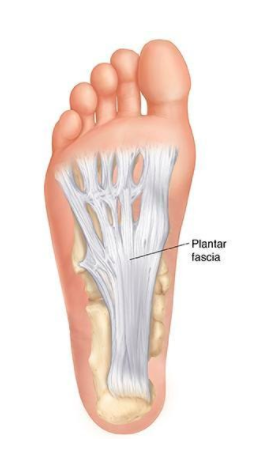
The plantar fascia is a thick, weblike ligament that connects your heel to the front of your foot. It acts as a shock absorber and supports the arch of your foot, helping you walk.

Too much pressure on your feet can damage the ligaments in turn causing this structure to be inflamed or degenerate faster making it painful and stiffness.

Symptoms:

  • The pain is usually worse in the morning when you take your first steps out of bed
  • if you’ve been sitting or lying down for a while, the first few steps that you take will normally be painful
  •  Climbing the stairs can be 
  • After prolonged activity on your feet causes it to flare up and People with plantar fasciitis don’t usually feel pain during the activity, but rather just after stopping.

So how can we fix this problem?

  1. Ice and anti inflammatory drug
  2. Change footwear with good support and heel pad 
  3. Golf ball stretches
  4. Calf stretch

Here at Capital Physiotherapy, our physiotherapists are the experts in helping you to fix your foot issues as well as all the discomfort that comes with it!

We can help you break this habit and lead a healthier and pain free lifestyle. 

Our physiotherapist will be able to give you individualised advice/ treatment plan that is tailored for your particular needs.

 At Capital Physiotherapy, your initial appointment is 40-60minutes long. This allows our physios to be thorough in their assessment, as well as giving them enough time to give you treatment on the same consultation! 

If you have questions and concerns about physiotherapy, don’t hesitate to give our South Yarra physio at 0401 865 333 or you can do online booking. We also provide Telehealth Consultation for your safety and convenience during this time.

Inner Ankle Pain While Running?

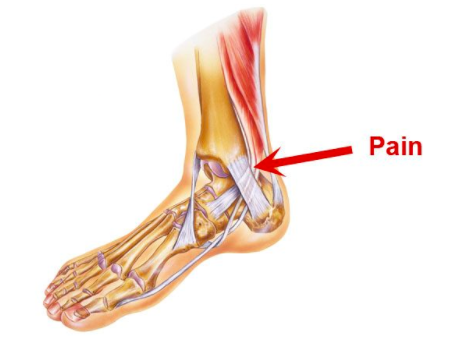
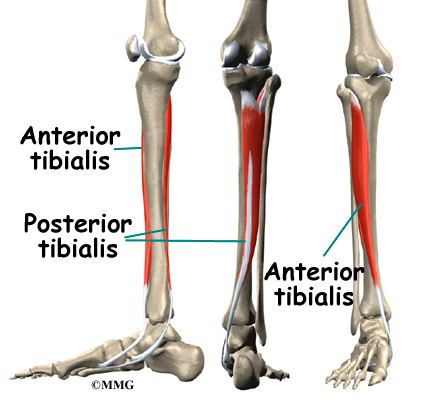
If you are experiencing pain right at this area while you are running and sometimes it travel up to your leg then you most likely suffers from what we call Posterior Tibial Tendonitis.

This problem is commonly seen in runners or hikers.

This muscle is located in the deep compartment of the lower leg, and is a key stabilising muscle of the ankle, supporting the medial arch of the foot.

So what causes your muscles to start hurting?

  1.  Incorrect technique used over a period of time (running or hiking)
  2.  Flat Feet; People who suffer from these problems either have flat feet to begin with or develop a flat foot if this issue is not properly fixed and it can lead to multiple other ankle injuries when left untreated.
  3. Weak ankle stabiliser muscles– because the ankle stabiliser are weak they are unable to cope the the amount of load that you are trying to put them through with your activities hence they started getting injured
  4. Weak Calf muscles;The bigger muscles group are suppose to do most of the work such as running or long distance hiking however if they are weak, your stabiliser muscles will have to do dual task both stabilising the ankle joint and also helping to do the actual movement, so inevitably, it gets overworked leading to injuries

How to fix it?

  1. Hence to go about fixing this problem we first need to correct your technique 
  2. Then we need to improve your flat feet issues 
  3. Strengthen your injured ankle stabiliser muscles (Tibialis Posterior)
  4. Strengthen your calf muscles so they are strong enough to do the activities you want them to do! 

Here at Capital Physiotherapy, our physiotherapists are the experts in helping you to fix your ankle issues as well as all the discomfort that comes with it!

Want to know more about Melanie – Our Hawthorn Physiotherapist?

Our physiotherapist, Melanie Lim, has a Bachelor of Physiotherapy Graduate from the University of Melbourne.

capital physiotherapy hawthorn clinic's physiotherapist Melanie Lim profile shotWith her wealth of clinical experience – in both public and private systems, Melanie is contactable at Capital Physiotherapy’s Hawthorn Physio clinic to provide you with the best physio treatment in the Hawthorn and for the surrounding suburbs.

At the Hawthorn physio clinic, Capital Physiotherapy offer bulk billing for their patients. Get in contact with Melanie today and book an appointment for a one on one session with her!She has completed advance training to specialise in a range of physical therapy treatments such as sport, dance, pre and postnatal, and dry needling. With a keen interest in treating and educating her clients (and YouTube audience), she aims to create custom pain treatment management plans for the Hawthorn community, and Melbourne at large.

Additional Information:

We also provide Telehealth Consultation for your safety and convenience during this pandemic.
Keeping in mind these tips/advice are of general nature and do not take your injuries/history into considerations. If you are experiencing any pain or would like an individualised tailored program to help improve your dancing, I highly recommend you speak to any one of your physiotherapists to guide you through your rehab journey.

Here at Capital Physiotherapy, our women’s health physiotherapists are the experts in helping you to fix your issues as well as all the discomfort that comes with it!

We can help you lead a healthier and pain free lifestyle.

Our physiotherapist will be able to give a full assessment on you and come out with individualised advice/ treatment plan that is tailored for your particular needs.

At Capital Physiotherapy, your initial appointment is 40-60minutes long. This allows our physios to be thorough in their assessment, as well as giving them enough time to give you treatment on the same consultation!

For any physiotherapy related concerns drop us an email info@capitalphysiotherapy.com.au 

Our Physiotherapy Clinics in Melbourne

Why Are Knock Knees Not Allowed in the Army


Knock knees are what we call (Valgus knee) in the medical term.

Knock knees can be one of the reasons to be deemed unfit for defence forces. 

Why are knock knees not allowed in the army?

Answer is simple, in the military training you will need to go through vigorous physical training i.e Long distance running 30-40km, long standing, heavy lifting, crawling, climbing etc.

If you have knock knees, your knees will not be able to cope with the amount of load needed in the military training. Hence, even if they allow you to join the training, sooner or later you will most likely find that your knees will not be able to cope with all these physical demands.

Those medical prerequisites are put in place for the health of the applicants. 

If you have knock knees you are naturally at a higher risk of getting knee injuries such as

  • Meniscus tear
  • Knee early arthritis
  • Knee ligament strain
  • Knee Capsule strain

Having said that, most people with knock knees live their life fine with no need for surgical intervention. People who generally experience pain and need surgeries are generally the more severe cases and also if they put too much physical load on the knee via exercises or work in their daily activities.

Hence, it is important that if you have knock knees that you do the right exercises to keep your knees and legs strong and avoid high impact activities to slow down the progression of the wear and tear of your knee structures.

Here at Capital Physiotherapy, our physiotherapists are the experts in helping you to fix your posture/alignment issues as well as all the discomfort that comes with it!

Want to know more about Melanie – Our Hawthorn Physiotherapist?


Meet Melanie Lim, a Bachelor of Physiotherapy Graduate from the University of Melbourne. She has gained a wealth of clinical experience through both public and private systems during her undergraduate studies to be here today at Capital Physiotherapy’s Hawthorn Physio clinic

capital physiotherapy hawthorn clinic's physiotherapist Melanie Lim profile shot

At the Hawthorn physio clinic, Capital Physiotherapy offer bulk billing for their patients. Get in contact with Melanie today and book an appointment for a one on one session with her!She has completed advance training to specialise in a range of physical therapy treatments such as sport, dance, pre and postnatal, and dry needling. With a keen interest in treating and educating her clients (and YouTube audience), she aims to create custom pain treatment management plans for the Hawthorn community, and Melbourne at large.


Additional Information:

We also provide Telehealth Consultation for your safety and convenience during this pandemic.
Keeping in mind these tips/advice are of general nature and do not take your injuries/history into considerations. If you are experiencing any pain or would like an individualised tailored program to help improve your dancing, I highly recommend you speak to any one of your physiotherapists to guide you through your rehab journey.

Here at Capital Physiotherapy, our women’s health physiotherapists are the experts in helping you to fix your issues as well as all the discomfort that comes with it!

We can help you lead a healthier and pain free lifestyle.

Our physiotherapist will be able to give a full assessment on you and come out with individualised advice/ treatment plan that is tailored for your particular needs.

At Capital Physiotherapy, your initial appointment is 40-60minutes long. This allows our physios to be thorough in their assessment, as well as giving them enough time to give you treatment on the same consultation!

For any physiotherapy related concerns drop us an email info@capitalphysiotherapy.com.au 

Our Physiotherapy Clinics in Melbourne

How to Fix my Lower Back Pain Forever

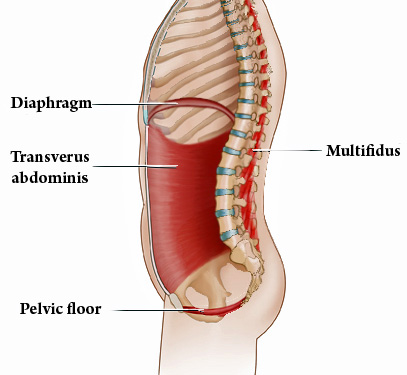
There are 4 different groups of muscles that work together to keep our lower back stable. Just working on the core alone, will not fix your lower back pain!

1. The Primary Sling

The Primary Sling also known as the transverse abdominis muscles. These muscles wrap around your spine like a back brace and it acts like a back brace to help support your back and it is the most common “core” muscles that people are talking about to help lower back pain in the mass market.

2. Posterior Oblique Sling muscles

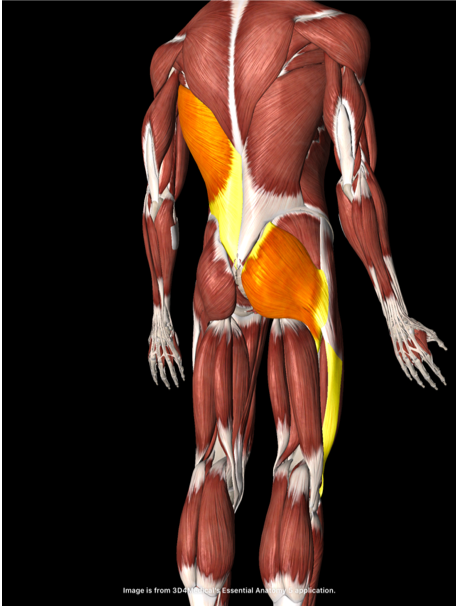
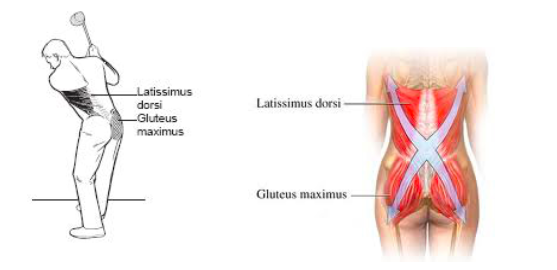
The posterior oblique sling muscles consist of our latissimus dorsi muscles and our gluteal muscles working together to create this cross section force which helps stabilise your lower back. It is especially useful to stabilise movement like twisting and bending over.

3. Anterior Oblique Sling muscles

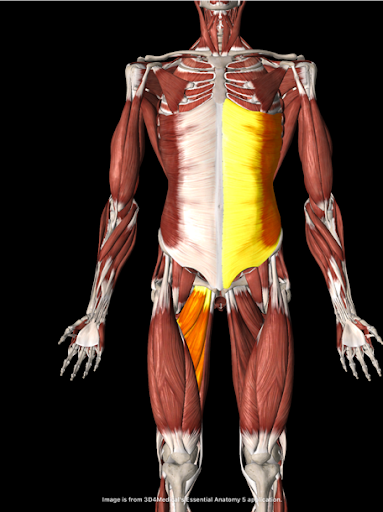
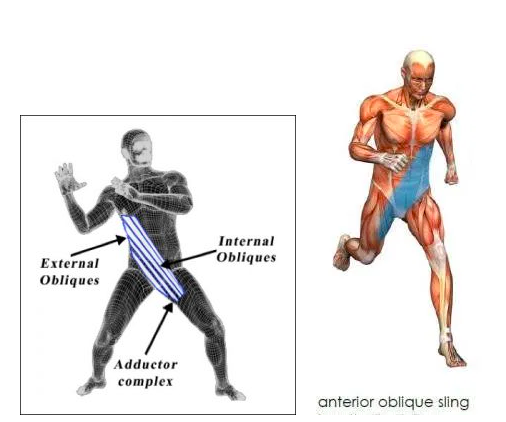
Our Anterior Oblique Sling consists of the external oblique muscle and your inner thigh muscles. These muscles work together to stabilize the front of your trunk in movement like running, and throwing action.

4. Lateral Sling

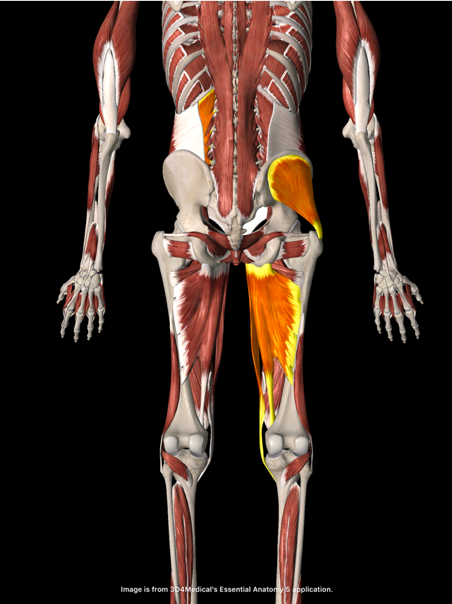
Our Lateral Sling consists of the gluteus medius muscles and the inner thigh muscles. They work together to keep you hip and pelvis in the perfect alignment when you are moving.

Any one of these groups that is weak will cause lower back discomfort.

In this video, I will show you some tips on what you can do to help strengthen these muscles groups. 

Keeping in mind these exercises are just the basic exercise that we start off with to fully fix your lower back injuries you will still need to continue to progress to harder and more functional exercises in order to feel pain free in your daily activities.

Here at Capital Physiotherapy, our physiotherapists are the experts in helping you to fix your shoulder issues as well as all the discomfort that comes with it!

We can help you break this habit and lead a healthier and pain free lifestyle. 

Our physiotherapist will be able to give you individualised advice/ treatment plan that is tailored for your particular needs.

 At Capital Physiotherapy, your initial appointment is 40-60minutes long. This allows our physios to be thorough in their assessment, as well as giving them enough time to give you treatment on the same consultation! 

If you have physiotherapy related concerns, visit our Footscray clinic or the one nearest you or drop an email at info@capitalphysiotherapy.com.au. We also have Telehealth Consultation for your safety and convenience during this pandemic.
Runner’s Knee

Experiencing knee pain while you are running? 

Then this is the video for you:

There are 2 different type of runner’s knee pain that we commonly see in our clinic

  1. Patellofemoral Pain Syndrome (PFPS) – Around the kneecap area
  2.  ITB syndrome -pain on the outside of your knee

Both are caused by the similar origin.

[supsystic-tables id=3]

Keeping in mind these exercises are just the basic exercise that we start off with to fully fix your knee injuries you will still need to continue to progress to harder and more functional exercises in order to feel pain free while running.

Here at Capital Physiotherapy, our physiotherapists are the experts in helping you to fix your knee issues as well as all the discomfort that comes with it!

We can help you improve your running efficiency and lead a healthier and pain free lifestyle. 

Our physiotherapist will be able to give a running assessment on you and come out with individualised advice/ treatment plan that is tailored for your particular needs.

At Capital Physiotherapy, your initial appointment is 40-60minutes long. This allows our physios like in Footscray area to be thorough in their assessment, as well as giving them enough time to give you treatment on the same consultation! 

For any physiotherapy related concerns, visit us at any of our clinics near you or make an online booking using this link. We also provide Telehealth Consultation for your safety and convenience during this pandemic.

Pain on Shoulder When I Raised My Arm

If you have been diagnosed with:

  • Shoulder tendinitis
  • Shoulder bursitis
  • Rotator cuff injury
  • Bicep tendonitis

Most shoulder injuries are caused by poor biomechanic of :

1. shoulder blade movement and also

2. poor shoulder joint control

Basic shoulder joint explanation.

Video About Impingement

1. kinesiology of scapular 

2. kinesiology of shoulder joint

As these injuries are mostly due to poor shoulder blade control which leads to you constantly putting your shoulder stabiliser muscles at risk of injuries.

You then might ask “ So what can you do to start improving your shoulder blade muscles control?”

We do have a useful video over here so don’t forget to check it out after this video.

The most recent video teaches the basic exercise that we normally give for most clients with shoulder injuries.

Keeping in mind these exercises are just the basic exercise that we start off with to fully fix your shoulder injuries you will still need to continue to progress to harder and more functional exercises in order to feel pain free in your daily activities.

Here at Capital Physiotherapy, our physiotherapists are the experts in helping you to fix your shoulder issues as well as all the discomfort that comes with it!

We can help you break this habit and lead a healthier and pain free lifestyle. 

If you are suffering from should pain or any physiotherapy concerns, you may visit one of our clinics near you or book online using this link. We also provide Telehealth Consultation for your safety and convenience during this pandemic.

Why Does My Hip Pop When I Do Leg Raises?

Hip popping is also known as “Snapping hip syndrome

SHS is more common in women, though it can affect people of all genders and ages.

There are three main types of snapping hip syndrome:

  • Internal. Usually caused by your hip flexor muscles rubbing against a bony prominence at your hip 
  • External. Usually caused by your side hip muscles rubbing against a bony prominence. 

The youtube video that we created will show you some simple exercises that will help kick start your internal and external snapping hip problem.

  • Intra-articular. In this category, a snapping hip is caused by an actual hip joint issue or injury. Unlike external or internal SHS, intra-articular SFS isn’t caused by a tendon or muscle. There is actual structural damage to the actual hip joint  such as cartilage, labrum tear etc.

These are actual joint damage and I highly recommend you go see a physiotherapist to get it treated ASAP. You don’t always have to end up in surgery in these cases but it is also not something you can fix on your own 🙂

Here at Capital Physiotherapy, our physiotherapists are the experts in helping you to fix your posture/alignment issues as well as all the discomfort that comes with it!

Want to know more about Melanie – Our Hawthorn Physiotherapist?


Meet Melanie Lim, a Bachelor of Physiotherapy Graduate from the University of Melbourne. She has gained a wealth of clinical experience through both public and private systems during her undergraduate studies to be here today at Capital Physiotherapy’s Hawthorn Physio clinic.

capital physiotherapy hawthorn clinic's physiotherapist Melanie Lim profile shot

At the Hawthorn physio clinic, Capital Physiotherapy offer bulk billing for their patients. Get in contact with Melanie today and book an appointment for a one on one session with her!She has completed advance training to specialise in a range of physical therapy treatments such as sport, dance, pre and postnatal, and dry needling. With a keen interest in treating and educating her clients (and YouTube audience), she aims to create custom pain treatment management plans for the Hawthorn community, and Melbourne at large.


Additional Information:

We also provide Telehealth Consultation for your safety and convenience during this pandemic.

Keeping in mind these tips/advice are of general nature and do not take your injuries/history into considerations. If you are experiencing any pain or would like an individualised tailored program to help improve your dancing, I highly recommend you speak to any one of your physiotherapists to guide you through your rehab journey.

Here at Capital Physiotherapy, our women’s health physiotherapists are the experts in helping you to fix your issues as well as all the discomfort that comes with it!

We can help you lead a healthier and pain free lifestyle.

Our physiotherapist will be able to give a full assessment on you and come out with individualised advice/ treatment plan that is tailored for your particular needs.

At Capital Physiotherapy, your initial appointment is 40-60minutes long. This allows our physios to be thorough in their assessment, as well as giving them enough time to give you treatment on the same consultation!

For any physiotherapy related concerns drop us an email info@capitalphysiotherapy.com.au 

Our Physiotherapy Clinics in Melbourne

Cervigogenic Headache

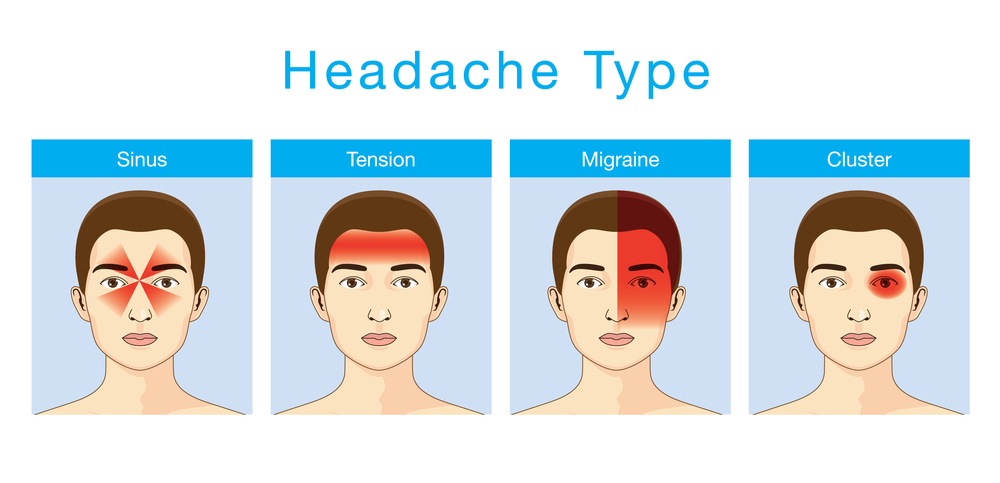
What is Tension Headache?How can I treat it?

Do you commonly wake up with a headache?

Do you get a headache after sitting in front of the computer for too long?

Does your headache start from the back of your neck and radiate to the front of your head?

You’ve got a tension headache or what is commonly known as “cervicogenic headache” in the medical world.

Don’t worry there is nothing wrong with your brain!

Tension headache signs and symptoms:

  • Dull, aching head pain
  • Sensation of tightness or pressure across your forehead or on the sides and back of your head
  • Tenderness on your scalp, neck and shoulder muscles

Tension headache can be the cause of:

Watch our YouTube Video to learn more.

To learn 5 simple methods that you can do at home to relieve your headache.

To fix your cervicogenic headache you must first stretch the tight component which is what we are showing you today. Once you have stretched these tight structures you will then need to move on to strengthening your postural muscles.

Here at Capital Physiotherapy, our physiotherapists are the experts in helping you to fix your posture and all the discomfort that comes with it!

We can help you break this habit and lead a healthier and pain free lifestyle. 

Our physiotherapist will be able to give you individualised advice/ treatment plan that is tailored for your particular needs.

At Capital Physiotherapy, your initial appointment is 40-60minutes long. This allows our physios to be thorough in their assessment, as well as giving them enough time to give you treatment on the same consultation! 

If you have physiotherapy concerns, you may visit one of our clinics nearest to you or do online booking using this link. You can also choose to have  Telehealth Consultation for your safety and convenience during this pandemic. 

Why Can’t I Squat Deeper

How Can I Squat Deeper?

Squat is one of the most commonly asked questions from our clients

  • Why can’t you squat?
  • Is my squat technique correct? 
  • Why do I feel it in my back instead of my legs?
  • I Don’t feel my glutes muscles working at all when i squat 

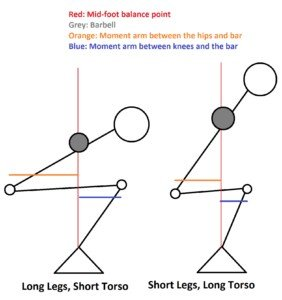
Here’s the thing that no one ever talks about the fact that squat loads up on different muscle groups/ structures depending on the person’s body type.

Hence, it’s normal for different people doing the same squat but feeling at a completely different muscle group just because their body build is different!

All these factors influence the quality of squat for different individuals. Watch our youtube video so you can understand how different body structure will interrelate to the ability to squat.

  • Centre of mass has to be over your feet to stay balance
  • Dist Knee to line of gravity
  • Distant of Hip to line of gravity
  • Amount of Trunk leaning over the line of gravity

Load on knee depends on how far your knee is when you squat to the line of gravity

So if your knee is far away from the line of gravity the higher the load

It is the same concept for Load of the hip depends on distance from your hip to the line of gravity

The load of your back depends on how far the trunk leans over the line of gravity. 

As the hip muscles are generally stronger than knee  muscles; the lever arm from hip to centre is generally larger than the lever arm from knee to the centre.

Normally the ratio should be 2:1 for an ideal squat BUT

With different people being build differently it changes this ratio and your ability to squat

The amount that your trunk have to lean forward depend on the lever arm of the hip to the line of gravity

The lesser the length on hip to centre the less your trunk has to lean, the longer the length of hip to centre, the more the trunk has to lean to stay balanced.

1. People with limited dorsiflexion ability (tightness or joint mobility is limited)- affect your ability to move your tibia forward, that in turn change the lever arm for your knee to the line of gravity

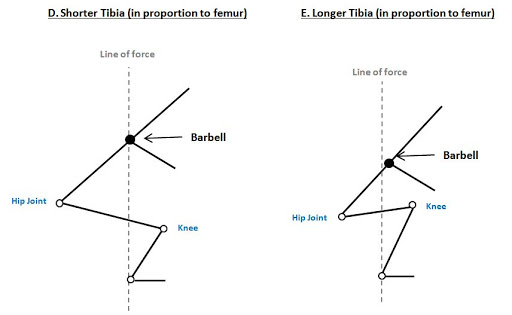
2.Proportion of Femur to Tibia

Short Tibia in proportion to femur, ability to squat lower; the back need to bend way forward to keep centre of mass over the feet (in order to stay balance) because the length of knee to line of gravity is really short

Long Tibia in proportion to femur, the line of gravity to the knee is longer hence the person doesn’t have to lean as far forward to keep their balance.


Because of these differences in lever arm it makes how each individual feels different when they are doing squat exercises.

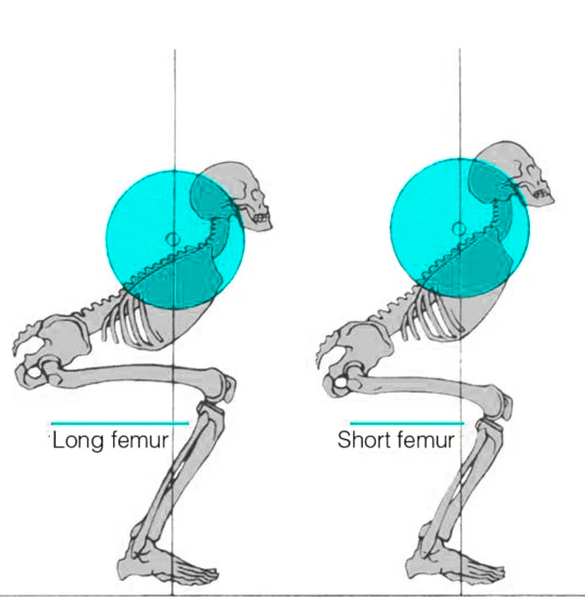
LONG FEMUR compared to tibia?


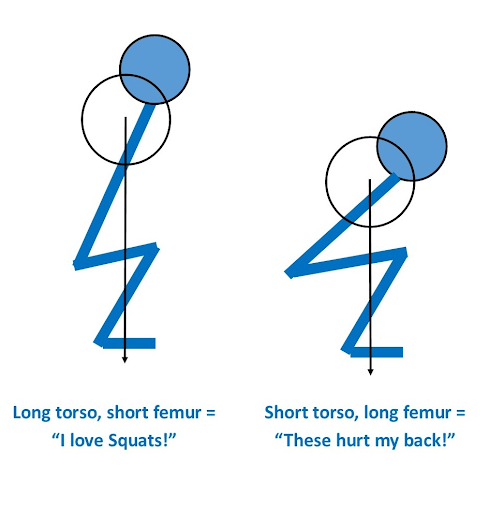
If you have a long femur in proportion to tibia, your lower back will need to lean significantly forward  to keep the equilibrium, in order to get any lower you might feel like you are falling backwards. You might just physically can’t do it because of the proportion of your build.

If your trunk is short and you have a long femur it makes it even worse as you can compensate by leaning too far forward so you will be even higher in their squat and you will feel the load a lot on your hip and lower back.

All these factors are interdependent and it will affect how each individual feels about squat and the ability of each individual to squat.

So if you are really struggling with your squat technique even though you’ve been working on your hip flexibility, your ankle flexibility, your back, glute and leg strength and you are wondering why you are still struggling with squat, this might be the reason and for that i say, DON’T SWEAT IT!

Squat is a good exercise to work on all different muscles groups but so is leg press, back extension, lunges, deadlift, hip trust etc. there are plenty of other exercises you can do that will work the same muscles group as squatting does. If  you really struggle in a squat and it is frustrating you, don’t sweat it, it’s not the end of the world, it’s just not the right exercise for you!

Here at Capital Physiotherapy, our physiotherapists are the experts in helping you to fix your posture/alignment issues as well as all the discomfort that comes with it!

We can help you break this habit and lead a healthier and pain free lifestyle. 

Our physiotherapist will be able to give you individualised advice/ treatment plan that is tailored for your particular needs.

At Capital Physiotherapy, your initial appointment is 40-60minutes long. This allows our physios to be thorough in their assessment, as well as giving them enough time to give you treatment on the same consultation! 

For physiotherapy related queries and concern, visit us at any of our clinics near you or do an online booking with us. We also provide Telehealth Consultation for your safety and convenience during this pandemic.